
code: 1030
Description
Salvia sclarea var. turkestanica, better known as Clary Sage, has been cultivated in botanical gardens for centuries. Its uses are diverse: from flavoring wines, producing essential oils for perfumes, to use in potpourri and incense. Medicinally, it is traditionally believed to aid digestion, soothe stomach ailments, and even have anti-aging properties. Most importantly, it is a stunning plant that thrives on minimal care.
Clary Sage grows easily in well-drained soil, in full sun or partial shade, tolerates poor soil, resists slugs and pests, and doesn’t require staking. The large, grey-green leaves remain attractive all season long, even in dry conditions.
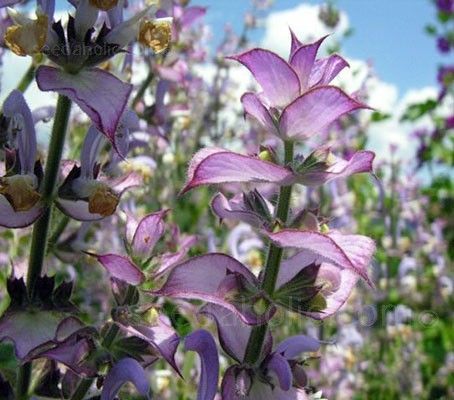
The plant has an architectural quality, with branched stems topped with profuse pale blue flowers and large pinkish-white bracts. These blooms rise above aromatic mid-green leaves up to 23 cm (9 in) long and attract bees and butterflies, making it a garden favorite for pollinators.
Organic Seed
This seed has been organically produced, harvested from plants grown to recognized organic standards without the use of chemicals. The seed is supplied in its natural state and carries the Organic certification symbol.
Sowing
Timing
Sow late summer to early winter for spring flowering the following year.
Clary Sage is biennial: the first year produces a rosette of leaves and roots; the second year it flowers, sets seed, and dies.
Indoors
Surface sow in pots or containers with good-quality seed compost.
Cover lightly with compost or vermiculite.
Keep moist but not wet. Seeds germinate in 7–10 days at 20°C (68°F).
Prick out seedlings as they grow and transplant to 7.5 cm (3 in) pots.
Gradually acclimate seedlings to outdoor conditions over 10–15 days before planting after the last frost.
Direct Sowing
Sow outdoors directly in the intended flowering location or a sheltered seed bed.
Space seedlings 15 cm (6 in) apart.
Young plants require moderate watering, even though established plants are drought-tolerant.
Cultivation
Clary Sage is low-maintenance and resilient. It tolerates poor soils but produces larger, lush plants in rich, well-watered soil.
Thrives in sun or light dappled shade, but does not tolerate full shade or boggy soil.
Biennial cycle: Year one for leaves, year two for flowers and seeds. Cutting flower spikes can prolong bloom in arrangements, though the bracts are very attractive in the garden.
Uses
Garden
Flower borders and beds
Wildlife gardens – attracts bees and butterflies
Cut or dried flowers for arrangements
Culinary & Medicinal
Leaves can be used for tea or flavoring.
Traditionally used in digestive remedies.
Essential oils (sclareol) are valuable in perfumes, cosmetics, and aromatherapy.
Other Uses
Cultivated for cosmetic and fragrance industries.
Historically used in wines and liqueurs, including vermouth.
Origin & Habitat
Native to northern Mediterranean, parts of North Africa, and Central Asia.
One of the first Salvias described by the Ancient Greeks, who used it medicinally.
Belongs to the Lamiaceae (mint) family.
Nomenclature
Genus: Salvia – from Latin salveo, meaning “I am well” or “I am healed,” referring to medicinal uses.
Species: sclarea – from Latin clarus, meaning “clear” or “bright,” as tea from the leaves was believed to “clear the mind.”
Variety: turkestanica – “from Turkey.”
Common names: Clary, Clary Wort, Muscatel Sage, Clear Eye, Eye Bright.
Historically called Oculus Christi (“Eye of Christ”) in the Middle Ages, prized for its medicinal properties.