
Code:513
The fruit is a large
Family: Ranunculaceae
Common name: Nigella sativa, fennel flower, black seed, black cumin.
Plant Classification: Half hardy annual
Minimum Height: 20 cm
Maximum Height: 30 cm
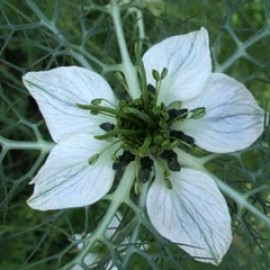
This pretty annual flowering plant is native to south and southwest Asia where it bears finely divided, linear leaves with delicate, starry flowers which are usually coloured pale blue and white, with five to ten petals. The fruit is a large, inflated capsule each containing numerous seeds which is used as a spice throughout the world.
Sowing advice:
For best results, seeds are sown directly into the ground where required in the spring. Alternatively, sow in late winter/early spring in gentle warmth, 15-20 degrees C. Prick out into small 3″ pots and plant in final position when the plants are established.
Can we eat Kalonji seeds daily?
Ayurveda recommends daily consumption of 20 grams of these seeds to enhance lubrication between joints, for maintaining a healthy heart, fight breathing problems and to prevent cancer, thanks to its anti-carcinogenic properties. Kalonji seeds are a storehouse of protein, carbohydrate, dietary fiber and fat.
How do you cook Nigella seeds?
Nigella seeds are tiny black seeds that are big on flavor and add piquancy to a range of dishes—from Indian curries to Middle Eastern flatbreads. Give them a toast in a dry skillet and wait for them to pop to release their aromatic properties.