
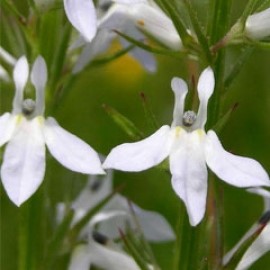
code: 760
It will thrive in sandy soils
Family: Campanulaceae
Common name: Pale-spike Lobelia
Plant Classification: Hardy perennial
Minimum Height: 30 cm
Maximum Height: 60 cm
This unusual American native displays spike-like racemes of white to pale blue tubular flowers over a long valuable period in that late summer gap. It will thrive in sandy soils that do not dry completely out and is very-long lived and makes a welcome trouble-free addition to your front or middle border where it will surely puzzle all of your friends who attempt to identify it!
Sowing advice:
For best results, sow seeds immediately onto a good soil-based compost. Cover the seeds with fine grit or compost to approximately their own depth. They can be sown at any time, and germination can sometimes be quicker if kept at 15 to 20 degrees C. However, we sow most seeds in an unheated greenhouse and wait for natural germination as many seeds have built-in dormancy mechanisms, and often wait for spring before emerging regardless of when they are sown. But spring sowing will obviously give them a full season of growth if successful germination occurs.
Characteristics
Habitat
terrestrial
New England state
- Connecticut
- Maine
- Massachusetts
- New Hampshire
- Rhode Island
- Vermont
Flower petal color
- blue to purple
- white
Leaf type
the leaves are simple (i.e., lobed or unlobed but not separated into leaflets)
Leaf arrangement
alternate: there is one leaf per node along the stem
Leaf blade edges
the edge of the leaf blade has teeth
Flower symmetry
there is only one way to evenly divide the flower (the flower is bilaterally symmetrical)
Number of sepals, petals or tepals
there are five petals, sepals, or tepals in the flower
Fusion of sepals and petals
the petals or the sepals are fused into a cup or tube
Stamen number
5
Fruit type (general)
the fruit is dry and splits open when ripe