
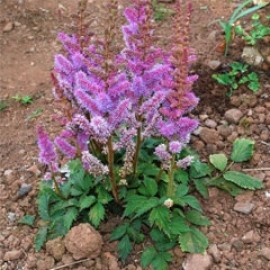
code: 580
Like all astilbes it rarely suffers from pests or diseases
Family: Saxifragaceae
Common name: Dwarf Chinese Astilbe
Plant Classification: Hardy perennial
Minimum Height: 15 cm
Maximum Height: 23 cm
This exceptional, early summer variety makes a dwarf, ground-hugging, rounded clump with bright red flowers, that performs well in almost any aspect or position, but will do especially well in shade or damp conditions or a moist, shady spot in the rock garden or by the pond. Feathery plumes of densely clustered flowers appear in late summer. Like all astilbes it rarely suffers from pests or diseases, and can be relied upon to bring colour to the garden year after year, this variety having been awarded an Award of Garden Merit (AGM), (Royal Horticultural Society, Plants of outstanding excellence.)
Sowing advice:
For best results, sow seeds immediately onto a good soil-based compost. Cover the seeds with fine grit or compost to approximately their own depth. They can be sown at any time, and germination can sometimes be quicker if kept at 15 to 20 degrees C. However, we sow most seeds in an unheated greenhouse and wait for natural germination as many seeds have built-in dormancy mechanisms, and often wait for spring before emerging regardless of when they are sown.
Gardening tips:
Astilbes are long-lived perennials that are most comfortable when grown in rich soil and light shade to filtered sun. They will grow in full shade, but will not bloom as prolifically there.
Though they are easy to grow, Astilbes have one critical requirement–lots of water. Plants must have consistently moist soil; dryness leads to a quick demise, especially in sun. Increase watering as the foliage emerges and the plumes mature. If the soil dries out, the leaves will develop brown, crispy margins and will begin to drop.
Fertilize Astilbes in late spring before flowering starts. Wait to cut back the old foliage until spring; it will help protect the plant from winter damage. In the spring, if the crown has risen above soil level, gently press it back into the ground and apply some organic matter around the plant. Plants should be divided in early spring every 3-4 years to maintain vigor.