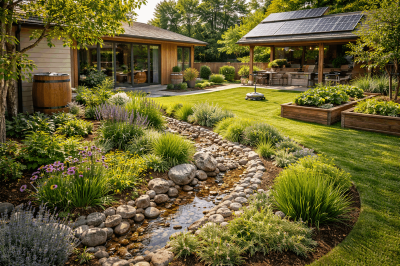
A Leadership Perspective on the Next Generation of Environmental Design
By Executive Leadership
Across every major industry, sustainability is no longer a future goal — it is a present-day business requirement. Real estate, construction, infrastructure, and environmental design are all undergoing rapid transformation driven by climate realities, regulatory pressure, and market demand for resilient, efficient properties.
One of the most overlooked — yet most powerful — opportunities for carbon reduction lies in how we design and manage outdoor environments. Carbon-Neutral Landscaping is emerging as a critical pillar of next-generation property strategy.
For forward-thinking organizations, developers, and property owners, landscaping is no longer simply aesthetic. It is now a measurable component of environmental performance, operational cost control, and long-term asset value.
The Strategic Shift: From Decorative Landscaping to Performance-Based Environmental Design
Historically, landscaping decisions were driven by visual appeal, short-term cost, and basic maintenance planning. While this approach served the market for decades, it is no longer sufficient in a climate-constrained economy.
Today, property performance must be evaluated holistically. Buildings do not exist in isolation — they are part of a broader environmental system that includes soil health, vegetation, water cycles, microclimate effects, and energy interaction.
Carbon-neutral landscaping reflects this shift. It focuses on balancing — or reducing below zero — the total carbon generated across the lifecycle of outdoor property development.
This includes emissions associated with:
Material production
Transportation logistics
Construction processes
Irrigation and maintenance energy use
Long-term landscape replacement cycles
At the same time, it maximizes natural carbon sequestration through soil management and vegetation systems.
This is not simply environmental stewardship — it is strategic asset optimization.
Why Carbon-Neutral Landscaping Is Becoming a Business Imperative
Several macro trends are accelerating adoption:
Climate Risk and Resilience Requirements
Extreme weather, water scarcity, and heat stress are increasing operational risks for properties. Landscape design now directly impacts property resilience.
Regulatory Evolution
Environmental standards and emissions accountability are tightening globally. Early adopters gain compliance advantages.
Investor and ESG Pressure
Institutional investors are prioritizing assets with measurable sustainability performance.
Market Differentiation
Consumers increasingly prefer environmentally responsible properties — especially in premium and future-focused markets.
Carbon-Neutral Landscaping as a Long-Term Cost Optimization Strategy
There is a persistent misconception that sustainable landscape design increases costs. In reality, lifecycle analysis consistently shows the opposite.
Carbon-neutral landscaping reduces:
Long-term irrigation costs
Energy costs related to heat island effects
Replacement and repair cycles
Environmental compliance risks
Stormwater infrastructure costs
In many cases, sustainable landscape strategies outperform traditional designs financially within a few years of implementation.
The Role of Vegetation as Carbon Infrastructure
Trees and vegetation should be viewed as long-term infrastructure assets.
Strategically designed vegetation systems:
Capture atmospheric carbon
Reduce ambient temperatures
Lower building cooling loads
Improve air quality
Increase biodiversity stability
Mature trees alone can offset significant annual carbon emissions while providing measurable economic benefits through energy savings and comfort improvements.
Soil: The Hidden Carbon Asset
Modern environmental design recognizes soil as a major carbon storage system.
Healthy soil ecosystems increase carbon sequestration capacity through organic matter retention and microbial activity. Regenerative soil management strategies are becoming standard in high-performance landscape design.
This transforms landscape maintenance from a cost center into a long-term environmental asset.
Materials: The Next Frontier in Carbon Reduction
Construction materials often represent the largest carbon footprint component in landscape projects.
Forward-looking strategies include:
Local material sourcing
Low-carbon concrete alternatives
Recycled construction materials
Permeable surface systems
Sustainably harvested wood products
Material selection decisions made during design phase can influence emissions impact for decades.
Water Intelligence and Energy Interconnection
Water management is fundamentally an energy issue. Every stage of water distribution — pumping, treatment, transport — carries an energy cost.
Carbon-neutral landscape design integrates:
Smart irrigation systems
Climate-adaptive watering schedules
Rainwater harvesting systems
Soil moisture retention strategies
Native drought-tolerant planting
These systems reduce both water consumption and indirect energy emissions.
Technology as an Enabler of Carbon-Neutral Landscapes
The integration of environmental data is accelerating the transition toward performance-based landscape design.
Emerging tools include:
Soil and climate monitoring sensors
Predictive irrigation automation
Environmental performance modeling
Digital Twin simulation for property ecosystems
AI-assisted landscape optimization
These technologies move environmental performance from estimation to measurement.
Carbon-Neutral Landscaping and Climate Adaptation Strategy
Climate adaptation is now a core component of property planning.
Carbon-neutral landscape design supports adaptation by:
Reducing heat island effects
Managing stormwater overflow risk
Stabilizing soil against erosion
Increasing microclimate stability
Supporting ecosystem biodiversity
This directly protects long-term asset value.
The Competitive Advantage of Early Adoption
Organizations that adopt carbon-neutral landscape strategies early gain:
Financial Advantage
Lower operating costs and reduced long-term infrastructure risk.
Regulatory Advantage
Proactive compliance with future environmental standards.
Market Advantage
Stronger ESG positioning and brand differentiation.
Asset Longevity
Greater resilience against climate-driven damage and performance decline.
The Future: Integrated Net-Zero Property Ecosystems
The next decade will see integration between:
Net-zero building design
Carbon-neutral landscape infrastructure
Smart home automation systems
Environmental monitoring networks
Predictive climate performance modeling
The concept of a “smart property” will include full environmental system optimization — not just indoor automation.
Executive Outlook: The Next Decade of Sustainable Property Leadership
Carbon-neutral landscaping represents a fundamental shift in how outdoor environments are valued. Landscapes are transitioning from decorative features to measurable performance systems that influence energy efficiency, environmental resilience, and long-term financial returns.
Organizations that understand this shift today will define the next generation of property development standards.
The future of property design will be defined by data-driven sustainability, lifecycle carbon accountability, and integrated environmental intelligence.
Carbon-neutral landscaping is not an environmental trend.
It is a strategic business evolution.