
code: 637
A challenge to grow but worth the effort!
Family: Compositae
Common name: Himalayan Daisy
Plant Classification: Hardy perennial
Minimum Height: 45 cm
Maximum Height: 60 cm
Packet Content(approx.): 8
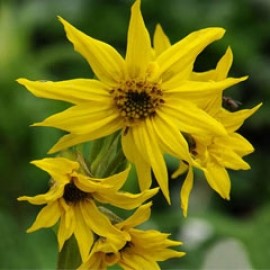
This rare and beautiful daisy, which bears nodding, dark-eyed yellow daisies with twisted petals, grows high in the Himalayas where it thrives in damp shady meadows. A challenge to grow but worth the effort!
Sowing advice:
Seeds can be sown at any time but are best sown in winter or early spring to benefit from a cold spell in the wet compost to break their dormancy. We advise covering seeds very thinly with sand or fine grit to about the depth of the seed size. If the seeds do not come up within 6 to 12 weeks the damp seed tray can be given cold treatment in a fridge for about four weeks. They may still take very many months to appear, so please never discard the pot or tray.
Cremanthodium are native to sunny or lightly shaded, alpine regions of Nepal, China and Tibet. There are about 50 species in total but only a handful are ‘common’ (I use that termed loosely) in cultivation. Plants produce a basal rosette of leaves and flower stems that rise 30-45 cm, ending in a medium-sized, nodding yellow daisy. They are delightfully fragrant. There are several reasons that Cremanthodium are not more popular. First, they need cool summer temperatures. Hence, their luxuriant growth at the Tromsö Botanical Garden. They also need evenly moist soil. The require an even snow cover in winter and barring that, will need a thick mulch to help them through the winter. They detest wet, soggy winters. All these growing requirements seriously narrows the regions where they can be successfully cultivated. Gardeners in higher elevations of the Appalachians, Atlantic Canada, drier areas of the Pacific Northwest and higher elevations of western North America have the best chance. They seem to do better in Europe as a whole, especially Scandinavian countries, Iceland, northern Scotland, and higher elevations of the Alps.