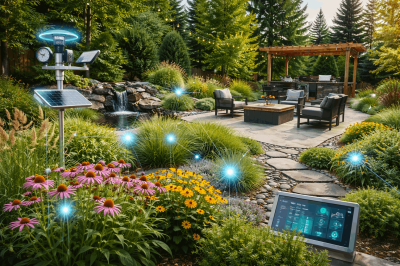
Redefining Green Spaces Through Data, Technology, and Climate Change
For decades, landscaping was primarily understood as an aesthetic practice—a series of decisions focused on planting, pathways, and shaping outdoor environments. Today, that definition has fundamentally changed. Modern landscaping has entered a new phase where technology, data, and artificial intelligence play a role equal to nature itself.
This shift is not merely technical. It reflects a deeper change in how humans relate to their environment. Green spaces are no longer decorative backdrops; they are living, dynamic, and analyzable systems capable of learning, adapting, and responding to future conditions.
The End of Intuitive Decision-Making
Traditionally, landscaping decisions relied heavily on personal experience, taste, and standardized design patterns. While effective in the past, these approaches struggle to address today’s environmental complexity and growing climate pressures.
Modern landscaping moves toward evidence-based decision-making. Every site has unique characteristics, and no single solution fits all environments. This is where artificial intelligence becomes essential—providing insight beyond intuition and enabling more precise, site-specific strategies.
Artificial Intelligence: The Analytical Core of Modern Landscapes
In contemporary landscaping, artificial intelligence functions as a continuous observer and intelligent analyst. It processes vast amounts of environmental data, including temperature fluctuations, soil moisture, precipitation patterns, sunlight exposure, and human usage behavior.
Unlike human analysis, which is limited by scale and simultaneity, AI systems identify hidden relationships between variables. This capability allows for a clearer understanding of current conditions and more accurate anticipation of future performance.
Landscaping as a Dynamic System
A defining principle of modern landscaping is systems thinking. Green spaces are no longer collections of isolated elements; they are interconnected networks where changes in one area affect the whole.
Artificial intelligence strengthens this systems approach by detecting early signals of change. Instead of reacting after problems appear, intelligent systems enable proactive adjustments, shifting landscaping from a reactive practice to a predictive and adaptive process.
Adaptability as the Core Feature of Future Landscaping
Natural environments are inherently unstable and continuously evolving. One of the greatest advantages of smart landscaping technologies is their ability to adapt to changing conditions.
Modern landscaping accepts uncertainty as a reality. Rather than attempting total environmental control, the goal is to create landscapes capable of adjusting to new circumstances. AI acts as an enabler—facilitating flexibility rather than enforcing rigidity.
A New Perspective on Climate Change Challenges
Climate change directly affects the performance and resilience of green spaces. Temperature extremes, shifting precipitation patterns, and unpredictable weather events increase the complexity of landscape management.
Traditional methods often fall short under these pressures. Modern landscaping responds by prioritizing analysis, forecasting, and risk reduction. By examining historical trends alongside real-time data, AI systems help identify likely scenarios and strengthen environmental preparedness.
Human Experience at the Center of Smart Landscaping
Despite the growing role of technology, modern landscaping remains fundamentally human-centered. The ultimate objective is to improve quality of life. Technology is a tool—not the goal itself.
Intelligent systems can analyze how people interact with outdoor spaces, identifying which areas attract the most use, when activity peaks, and which zones remain underutilized. This insight supports environments that feel more intuitive, comfortable, and naturally engaging.
From Decorative Design to Functional Landscapes
Modern landscaping increasingly shifts away from purely visual appeal toward performance and functionality. Aesthetic value still matters—but not at the expense of long-term sustainability or operational efficiency.
Every landscape element serves a defined purpose, justified by environmental logic. This functional mindset creates spaces that are more resilient, longer-lasting, and better aligned with real-world conditions.
A Future That Has Already Begun
What we recognize today as modern landscaping marks the beginning of a long-term transformation. As technology evolves, green spaces will become smarter, more flexible, and more responsive to their surroundings.
This future does not eliminate human involvement. Instead, it enhances informed decision-making, combining human judgment with analytical intelligence to produce landscapes that align with both ecological systems and modern lifestyles.
Data-Driven Landscaping: When the Environment Speaks
One of the most significant shifts in modern landscaping is the transition from surface observation to deep data-based understanding. Landscapes are no longer merely observed—they are interpreted.
Every subtle environmental change becomes a signal. When properly analyzed, these signals prevent larger failures and support long-term stability. In this approach, data functions as the language of nature.
Sensors: The Eyes and Ears of Smart Landscapes
At the heart of data-driven landscaping are environmental sensors. These tools collect information that was once difficult or expensive to measure accurately.
Sensors continuously monitor:
Environmental temperature
Soil moisture levels
Sunlight exposure
Atmospheric humidity
Overall site conditions
Collected data feeds into analytical systems, transforming raw measurements into actionable insights.
Continuous Analysis Instead of Periodic Inspection
Traditional landscaping relied on scheduled inspections, often identifying issues only after visible damage occurred. Modern landscaping eliminates this delay through continuous monitoring and analysis.
By focusing on trends rather than isolated snapshots, intelligent systems maintain higher environmental quality and long-term resilience.
Pattern Recognition Through Artificial Intelligence
One of AI’s strongest advantages is its ability to recognize complex patterns invisible to human observation. In landscaping, performance decline may result from subtle interactions between multiple variables rather than a single cause.
AI systems identify these relationships early, issuing warnings before problems become irreversible—supporting proactive landscape management.
Urban Landscaping as Critical Infrastructure
In urban environments, landscaping is no longer decorative—it is infrastructure. Green spaces influence air quality, water management, thermal regulation, and mental well-being.
Modern urban landscaping aims to:
Reduce environmental stress
Create breathable spaces
Support ecological balance
Enhance human-environment interaction
At this scale, smart technologies are not optional; they are essential.
Managing Complexity at Large Scales
As landscaping projects expand in scale, complexity increases. Public parks, urban corridors, and semi-natural environments require coordination across multiple systems.
Artificial intelligence integrates large datasets into coherent environmental models, enabling strategic and informed decision-making across extensive landscapes.
From Reaction to Prediction
One of the most important conceptual shifts in modern landscaping is the move from reactive responses to predictive management. Instead of acting after failure, systems anticipate potential futures.
These forecasts are not certainties—they are scenarios that improve preparedness, reduce risk, and increase adaptability.
Landscaping as an Ongoing Process
Traditional landscaping often treated projects as having clear beginnings and ends. Modern landscaping reframes green spaces as continuous processes that evolve over time.
AI-driven monitoring ensures ongoing evaluation and refinement, keeping landscapes in optimal condition rather than allowing gradual decline.
Bridging Nature and Technology
Contrary to common assumptions, technology does not separate humans from nature. In modern landscaping, technology acts as a bridge—deepening understanding and strengthening coexistence.
Rather than replacing natural systems, AI helps interpret them, resulting in landscapes that feel more natural while performing more effectively.
Long-Term Investment Value
A future-oriented view positions landscaping not as an expense but as a long-term investment. Smart, adaptive landscapes maintain and increase their value by enhancing resilience, livability, and environmental performance.
Challenges and the Need for Intelligent Approaches
Modern landscaping faces challenges including technological complexity, interdisciplinary knowledge requirements, and data management. However, ignoring this evolution presents even greater risks.
Smart landscaping offers a practical response to today’s environmental complexity and a framework for managing future uncertainty.
Final Conclusion
Modern landscaping in the age of artificial intelligence represents a profound transformation. Green spaces are becoming intelligent, adaptive, and future-ready systems—reflecting a deeper shift in how society engages with the environment.
Technology does not replace nature; it enhances understanding and supports informed coexistence. The result is landscapes that are not only visually appealing, but also resilient, adaptive, and aligned with modern life.
The landscape of the future is one that grows with people, adapts to its environment, and evolves with time.