
code: 800
The fruits are sweet and edible
Family: Arecaceae
Common name: Dwarf Date Palm, Stemless Date Palm
Plant Classification: Half hardy tree Greenhouse perennial
Minimum Height: 45 cm
Maximum Height: 60 cm
Packet Content(approx.): 10 large seeds
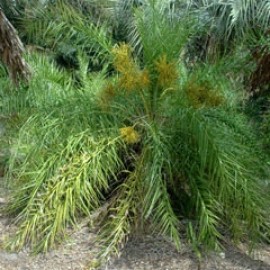
The trunks in this dwarf species remain mostly underground, rarely growing to more than a few inches high with grey-green leaves up to 4 or 5 feet long with 25 cm, pinnately arranged leaflets. The fruits are sweet and edible, and are commonly eaten by animals in the wild. This dwarf and bizarrely-attractive dwarf palm grows a rotund, semi-subterranean, suckering trunk, and has short pinnate leaves with thin leaflets. It is perfect for growing in a wide range of climates, from temperate to cool tropical, and is especially ideal for the smaller garden. It is also ideal for a hot dry and bright conservatory where its unusual form can be admired, and it is perfect when used as an unusual ground cover and is well suited as a potted specimen.
Sowing advice:
These seeds have already been thoroughly cleaned and should be sown into a well-drained, sandy compost at any time of the year, and covered thinly with sand or grit and kept moist. Keep at between 20-25 degrees C. Seeds sometimes germinate within 4 to 6 weeks although some varieties may take very much longer so please be patient. Plant out in the open ground in warmer countries or in a large container elsewhere.
Culture
Growth rate: Slow, Sunlight: full sun, Water: moderate, Cold Tolerance: 18° F or less.
Min. Temperature: 20°F (-12°C) Water Requirements: Regular water Sun Requirements: full sun, passed seedling stage.
Uses:
In times of scarcity, the bitter stem pith of P. acaulis has been used as a sago substitute (Blatter 1926). The fruits are sweet and edible, though scarcely fleshy, and are commonly eaten by animals (Roxburgh 1832). (S.C. Barrow. 1998)/Palmweb.