
code: 746
A truly amazing-looking plant producing positively inedible
Family: Solanaceae
Common name: Nipple Fruit, Sodom’s Apple, Titty Fruit, Cow’s Udder, Super Duper Titty Fruit, Fox Face, Five Fingered Eggplant
Plant Classification: Greenhouse perennial
Minimum Height: 1.0 meter
Maximum Height: 2.0 meters
Packet Content(approx.): 8
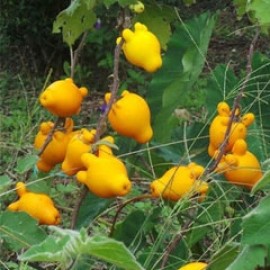
A truly amazing-looking plant producing positively inedible, ornamental fruits which resemble a cow’s udder at one end and human breast at the other, and with lots of rather rude common names too! Although it is perennial it can be grown as an annual, and is related to the naranjilla and tomato with large velvety leaves with purple veins and furry hair, along with prominent spikes. The branches and stems are also dotted with firm thorns. The pink-purple flowers develop during spring and are followed by the waxy, yellow colored fruit ripening a few months later. It has been used in traditional medicine for the treatment of athlete’s foot by hunters in Trinidad and also for irritability and restlessness. It is imported to Taiwan and Hong Kong as decorative foliage for use in religious and festival floral arrangements. They are also commonly used in building Chinese New Year trees due to their auspicious golden coloured fruit.
Sowing advice:
Seeds are surface-sown or covered only slightly. Do not allow the soil to dry out. Containers are held in warm conditions until sprouts appear, which may take anywhere from 3-10 days. Move sprouting plantings immediately to bright light conditions, such as a south-facing window. Inadequate light is a frequent cause of failure of young seedlings. At about the time of last frost, set out seedlings into grow bags. Plants need staking but there is no need to remove the side shoots.
Habitat
The plant is common on waste ground and field margins, especially near the sea, where it may also be found on cliff paths and near the shore.
Distribution:
Alexanders is native to continental Europe and has long been naturalised in Britain and Ireland where it is widely dispersed and – in addition to other disturbed habitats – commonly found on the sites of medieval monastery gardens as a persistent relic of former cultivation. Irish localities include: Counties Down, Antrim and Londonderry and throughout most of Ireland.