
code: 571
The trunk of the tree is often very wide for its height
Family: Fagaceae
Common name: Castanea sativa, Spanish Chestnut,
Plant Classification: Hardy tree
Minimum Height: 20.0 meters
Maximum Height: 35.0 meters
Packet Content(approx.): 4 huge seeds
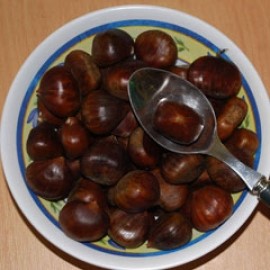
Shiny brown nuts ripen in prickly fruits whose thick casing has long, sharp, needle-like spikes (burrs), and usually two to four nuts per casing. Unlike most nuts, chestnuts have a high starch and water content but are low in protein and fat, and roasted are a popular and tasty traditional Christmas treat in Europe. The trunk of the tree is often very wide for its height, and is also recognisable by its deeply grooved bark. Its hardy nature means it still flourishes across large areas of central and western Europe but especially Great Britain where ancient specimens can be found.
Sowing advice:
These seeds have already been thoroughly cleaned and cold-stored for several months. They should be sown into well-drained, sandy compost at any time of the year, and covered to their own depth with sand or grit. No artificial heat is needed; the seed tray is best left in a cool spot outside and kept moist. Seeds germinate very slowly indeed in the spring after a chilling in the cold compost, regardless of when they are sown. Some seeds may take more than a year to germinate.
Uses:
Sweet chestnut has been listed as one of the 38 substances used to prepare Bach flower remedies, a kind of alternative medicine promoted for its supposed effect on health. However, according to Cancer Research UK, “there is no scientific evidence to prove that flower remedies can control, cure or prevent any type of disease, including cancer”.