code: 1032
Description
Sweet Cicely is an attractive perennial herb that makes a striking addition to herb gardens, borders, and hedgerows. Known for its sweet aniseed taste and fragrance, it flowers earlier than most other members of the carrot family, making it a useful precursor to plants like Ammi majus.
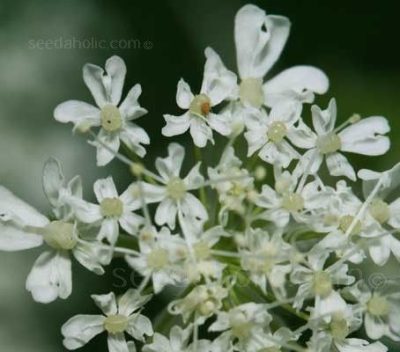
The plant grows up to 90 cm (36 in) tall, with finely divided, fern-like leaves that release a strong aniseed scent when crushed. From spring to early summer, delicate umbels of small white flowers appear, contrasting beautifully with the lush foliage.
Culinary Value
Historically, Sweet Cicely was widely cultivated as a culinary herb. Its natural sweetness makes it especially valuable for diabetics and anyone looking to reduce sugar intake. By adding Sweet Cicely to recipes, you can often cut sugar use by nearly half.
All parts of the plant—leaves, roots, seeds, flowers, and stalks—are edible:
Leaves: fresh in salads or chopped into soups, omelettes, and custards; cooked like spinach; or used with tart fruits like rhubarb, red currants, and gooseberries to reduce acidity.
Stalks: can be lightly cooked and used as a celery substitute.
Roots: eaten raw in salads, boiled like parsnips, or even made into wine.
Seeds: used green in salads, ice cream, custards, and fruit dishes; or dried and ground into spice blends. Young pods were once eaten as sweets by children.
Garden Use
Sweet Cicely is hardy to –20 °C (–4 °F), making it one of the earliest herbs to appear after winter and one of the last to die back. It thrives in sun or partial shade with moist, well-drained, humus-rich soil.
In the garden, it:
Pairs beautifully with other flowers thanks to its airy white umbels.
Attracts wildlife, bees, and butterflies (a valuable early nectar source).
Can self-seed freely in good conditions, so faded flowers should be removed to prevent unwanted spread.
Is difficult to grow in containers due to its long taproot, though large deep pots can work with care.
Sowing & Propagation
Direct Sowing (Best Method)
Sow seeds fresh in autumn into prepared seedbeds outdoors.
Seeds require a cold period over winter to germinate.
Thin seedlings in spring and transplant to final positions.
Stratification Method (Other Times of Year)
Mix seeds with damp sand or vermiculite.
Place in a sealed bag in the refrigerator for 4 weeks.
Sow into trays or pots afterwards, 1 seed per cell.
Transplant seedlings when large enough, planting out after frost.
Division
Best done in spring or autumn.
Cut the thick taproot into sections (each with at least one bud) and replant.
Harvest
Leaves: harvestable as early as late winter, and again through summer.
Seeds: pick unripe (green) for fresh flavor or ripe (brown/black) for storage.
Roots: dig in autumn for drying.
Note: Leaves and seeds don’t dry or freeze well, but seeds store reliably in a dry container.
Medicinal Uses
Sweet Cicely has been valued in herbal medicine for centuries. It is gentle, safe, and traditionally used as a tonic for digestion, appetite, and mood.
Leaves: tea made from dried or fresh leaves soothes the stomach and digestion.
Seeds: chewed after meals aid digestion.
Roots: once prepared with vinegar and oil, were recommended as a restorative for the elderly.
General: thought to purify the blood, uplift spirits, and calm gloomy thoughts.
Other Uses
Traditional ingredient in the herbal liqueur Chartreuse and Scandinavian aquavit.
Seeds and leaves used in furniture polish for wood, leaving a glossy finish and pleasant scent.
Known companion plant in herbal gardens, alongside anise, fennel, and caraway.
Origin & Identification
Native to Central Europe and the British Isles.
Found in woodlands, grassy banks, verges, and gardens.
Part of the Apiaceae family (carrot family).
Easily confused with other umbellifers (like hemlock), but safe identification is possible:
Lighter green fern-like leaves.
Strong aniseed smell when crushed.
Fine hairs on stems and seed pods (do not sting).
Nomenclature
Genus: Myrrhis (from Greek, meaning “smelling of myrrh”).
Species: odorata (Latin, “fragrant”).
Common names include: Greater Chervil, Cow Chervil, Smooth Cicely, British Myrrh, Shepherd’s Needle, Sweet Fern, Wild Myrrh.