
code: 662
“Greybeard grass”
Family: Poaceae
Common name: Greybeard Grass, Frost Grass, Silver Spikegrass
Plant Classification: Hardy perennial
Minimum Height: 90 cm
Maximum Height: 1.2 meters
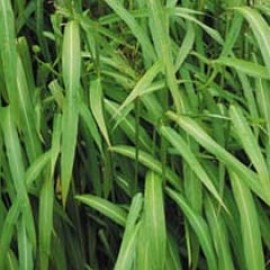
A very decorative grass with many names including “Greybeard grass”, “Frost Grass”, and “Silver Spike grass”. Stiff, white-centred broad leaves, turn burgundy in autumn, and plumes of purple spikelet’s wave from July until September, giving high garden value.
Sowing advice:
Sow at any time, in a well-lit position, into a good, soil-based compost. Cover seeds thinly and keep moist at around 15 degrees C or 60 degrees F. Some New Zealand species can be very slow indeed and may need cooler temperatures before they will come up. Grass seedlings should be potted on and grown on singly, or in clumps for more rapid establishment of a large specimen.
Botanical name:
Spodiopogon sibiricus
Genus:
Spodiopogon
Species:
sibiricus– S. sibiricus is a clump-forming, rhizomatous, deciduous perennial grass with erect culms bearing flat, broadly linear, mid-green leaves, often turning red or maroon in autumn, and, in summer, upright, open panicles of softly-hairy, purple flower spikelets ageing tan.
Foliage:
Deciduous
Habit:
Erect flower stem, Clump-forming, Upright
WHERE TO GROW:
Spodiopogon sibiricus (Frost grass) will reach a height of 1.5m and a spread of 1.2m after 2-5 years.
Suggested uses:
Low Maintenance, Cottage/Informal, Coastal, City, Beds and borders, Architectural, Planted in groups, Prairie planting
Cultivation:
Grows best in fertile, moist but well-drained soil in full sun. Tolerates light shade but form may be open or plant may flop. Does not tolerate drought. Tolerates pollution and coastal conditions.
Soil type:
Chalky, Clay, Loamy, Sandy (will tolerate most soil types)
Soil drainage:
Moist but well-drained
Soil pH:
Acid, Alkaline, Neutral
Light:
Partial Shade, Full Sun
Aspect:
North, South, East, West
Exposure:
Exposed, Sheltered
UK hardiness Note: We are working to update our ratings. Thanks for your patience.
Hardy (H4)
USDA zones:
Zone 9, Zone 8, Zone 7, Zone 6, Zone 5